<?xml version="1.0" encoding="utf-8"?><feed xmlns="http://www.w3.org/2005/Atom" ><generator uri="https://jekyllrb.com/" version="3.10.0">Jekyll</generator><link href="https://marcozaplan.github.io/feed.xml" rel="self" type="application/atom+xml" /><link href="https://marcozaplan.github.io/" rel="alternate" type="text/html" /><updated>2026-10-26T06:48:41+00:00</updated><id>https://marcozaplan.github.io/feed.xml</id><title type="html">Marco Zaplan</title><subtitle>Independent consulting and research on natural resource governance, open data, and public financial management.</subtitle><author><name>Marco Zaplan</name></author><entry><title type="html"></title><link href="https://marcozaplan.github.io/blog/2026/10/2018-02-14-philippines-will-train-run-over-the-mining-sec/" rel="alternate" type="text/html" title="" /><published>2026-10-26T06:48:41+00:00</published><updated>2026-10-26T06:48:41+00:00</updated><id>https://marcozaplan.github.io/blog/2026/10/2018-02-14-philippines-will-train-run-over-the-mining-sec</id><content type="html" xml:base="https://marcozaplan.github.io/blog/2026/10/2018-02-14-philippines-will-train-run-over-the-mining-sec/"><![CDATA[<p>In his July 2017 State of the Nation Address, Philippines President Rodrigo Duterte said he would tax miners to “death.” In December 2017, he signed Republic Act 10963–Tax Reform for Acceleration and Inclusion (TRAIN)—the first of six packages of a comprehensive program. TRAIN took effect on 1 January.</p>

<p>Under the new tax system, mining companies that extract metallic or non-metallic minerals are now subject to a 4 percent excise tax on the value of their production—double the previous rate. This excise tax is equivalent to what most countries would label a “royalty” on mineral production. What does this 100 percent increase mean for the sector?</p>

<p>National and local impacts of higher excise tax on minerals</p>

<p>Agata Mining Ventures (which operates in Agusan del Norte) paid 50,206,025 Philippine pesos (approximately USD 1 million) in excise taxes in 2016, according to the Fourth Philippine Extractive Industries Transparency Initiative (PH-EITI) Report. Assuming production and the price of the iron ore/nickel product it exports remain similar through 2018, it would then pay twice that amount to the government this year. Local government units (LGUs) hosting the Agata project are entitled to 40 percent of excise taxes, as is the case for all other LGUs. Under the new law and using the same assumption as above, Agata’s host LGUs could see their share from excise tax increase from an estimated PHP 20,082,410 (USD 390,000) to PHP 40,164,820 (USD 780,000).</p>

<p>The company’s feasibility study forecasts the a 10-year mine life for the Agata project. Assuming the average price of production according to the latest company’s consolidated financial statements, USD USD 18.6 USD per wet metric tonne, is the average price of production for those 10 years, the project would be paying about PHP 371 million (USD 7.2 million) in excise taxes under the new regime, instead of PHP 186 million (USD 3.6 million) before TRAIN.</p>

<p>The impact would be even more significant on larger projects, such as the King-king copper-gold project in the Compostela Valley province. Using assumptions from the 2013 preliminary feasibility study with updated gold, silver and copper prices, doubling the excise taxes could mean doubling the expected collection of excise payments from the company over the 22-year life of the project, from PHP 15.5 billion to PHP 31 billion (USD 300 to 600 million). Forty percent, or an estimated PHP 12.4 billion, would go to LGUs while the remaining PHP 18.6 billion would go to the national coffers.</p>

<p>In our simulations, both Agata and King-king would still be profitable to investors after considering the additional excise tax payments. But some marginal mining projects may be forced to close.</p>

<p>No mine is spared from the new tax hike. According to the fourth PH-EITI report (which covered 88 percent of total mineral production in the country), the Bureau of Internal Revenue (BIR) collected PHP 1.4 billion (USD 27 million) in excise taxes on minerals in 2016. Assuming production volumes and prices in 2018 are similar to 2016 figures, BIR should see collections of at least PHP 2.8 billion (USD 54 million) from excise taxes on minerals.</p>

<p>Provided the transfer of LGU shares from excise tax on minerals is sufficient and timely, the impact will be the biggest for host LGUs. However, because excise taxes are deductible expenses, companies would declare smaller profits and pay less income tax. Income tax is typically more evenly shared among the population and other jurisdictions via the government’s national budget. As a result, the net impact of higher excise taxes on the Philippines treasury should be positive, but more so for resource-rich than resource-poor regions.</p>

<p><strong>More to come?</strong>
The doubling of excise taxes on minerals may just be the tip of the iceberg for mining companies.</p>

<p>There are pending bills filed in both the Senate and House of Representatives that plan to impose 5 percent mineral royalties on all mining operations on top of the excise tax on minerals and other taxes paid by mining companies. Under the current policy, only companies operating in government-declared mineral reservations pay the 5 percent mineral royalties. In the PH-EITI report, only eight companies had reconciled payments for fiscal year 2016 that amounted to PHP 839 million (USD 16 million). If all companies were subject to the 5 percent royalty on the value of their production, the same base as the excise tax on minerals, the government could collect an estimated PHP 3.9 billion (USD 76 million).</p>

<p>The Department of Finance is planning to introduce additional changes in the mining fiscal regime in the final tax reform package, possibly imposing additional royalties and other fees. PH-EITI Focal Person and Assistant Secretary Maria Teresa S. Habitan in a press conference said the department will push through with its studies to propose a new mining fiscal regime.</p>

<p>As the Department of Finance studies new or increased taxes for the mining sector, it might consider some general principles from Precept 4 of the Natural Resource Charter.</p>

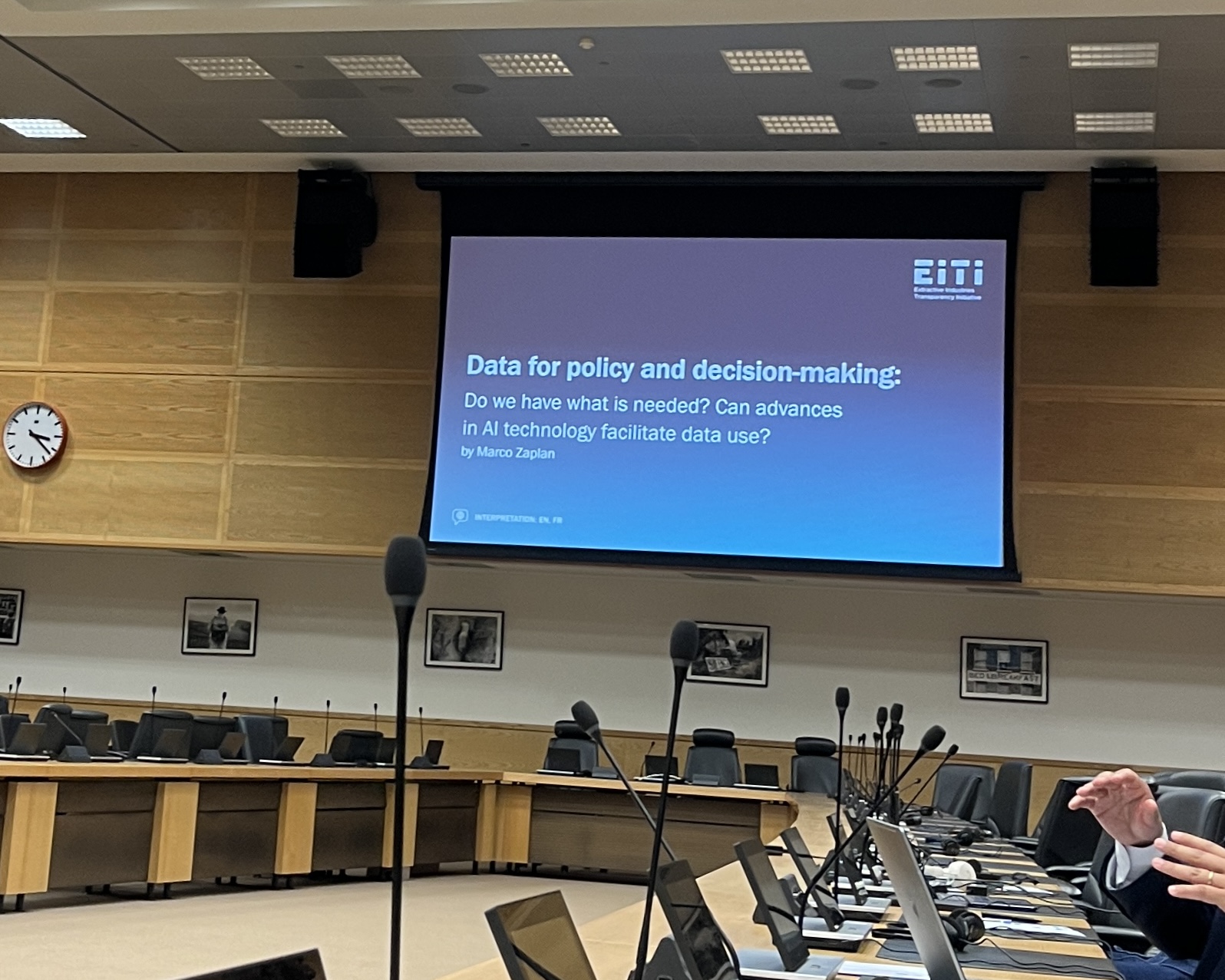
<p>Increasing excise taxes or royalties is a practical way of quickly increasing revenue collection, especially for local governments. It also makes marginal mineral deposits too expensive to exploit, and therefore slows down intensive mineral extraction. Pacing extraction could give the government leeway to progressively strengthen its rules and institutions. But if the goal of the government is to capture a greater share of mining revenues without restricting investment, the DoF should consider instead scrapping unnecessary incentives (like income tax holidays) and introducing more progressive taxes (such as resource-rent or windfall profit taxes that would only apply to highly profitable mines).</p>]]></content><author><name>Marco Zaplan</name></author></entry><entry><title type="html">How can we responsibly leverage AI in analyzing extractives data?</title><link href="https://marcozaplan.github.io/blog/2026/10/how-can-we-responsibly-leverage-AI-in-analyzing-extractives-data/" rel="alternate" type="text/html" title="How can we responsibly leverage AI in analyzing extractives data?" /><published>2026-10-11T00:00:00+00:00</published><updated>2026-10-11T00:00:00+00:00</updated><id>https://marcozaplan.github.io/blog/2026/10/how-can-we-responsibly-leverage-AI-in-analyzing-extractives-data</id><content type="html" xml:base="https://marcozaplan.github.io/blog/2026/10/how-can-we-responsibly-leverage-AI-in-analyzing-extractives-data/"><![CDATA[<p><img src="/assets/images/blog/eiti-presentation.jpg" alt="During the Peer Learning Day of the EITI Global Conference 2026 in Brussels, Belgium last 7 October 2026." /></p>

<p>Last October 7, I had the opportunity to speak at a session during the EITI Global Conference Peer Learning Day. I talked about how we can further facilitate the use of EITI data with the help of artificial intelligence (AI). I started by asking our participants to raise their hand if they’ve used AI particularly LLM tools in their work and the results were encouraging.</p>

<p><strong>Why an AI tool?</strong></p>

<p>Through the years, EITI has become one of the richest repositories of extractives data. And so the more important question now has become how we can further increase the use of these data that are often too technical for average citizens or are located in siloed repositories and in formats that are difficult to analyze.</p>

<p>This is where AI can come in which promises to make parts of our data work more efficient. With AI and large language models or LLMs such as ChatGPT and Claude, we can easily analyze EITI data and effectively lower the barriers for nontechnical people.</p>

<p><strong>What is EIDAn and how was it built?</strong></p>

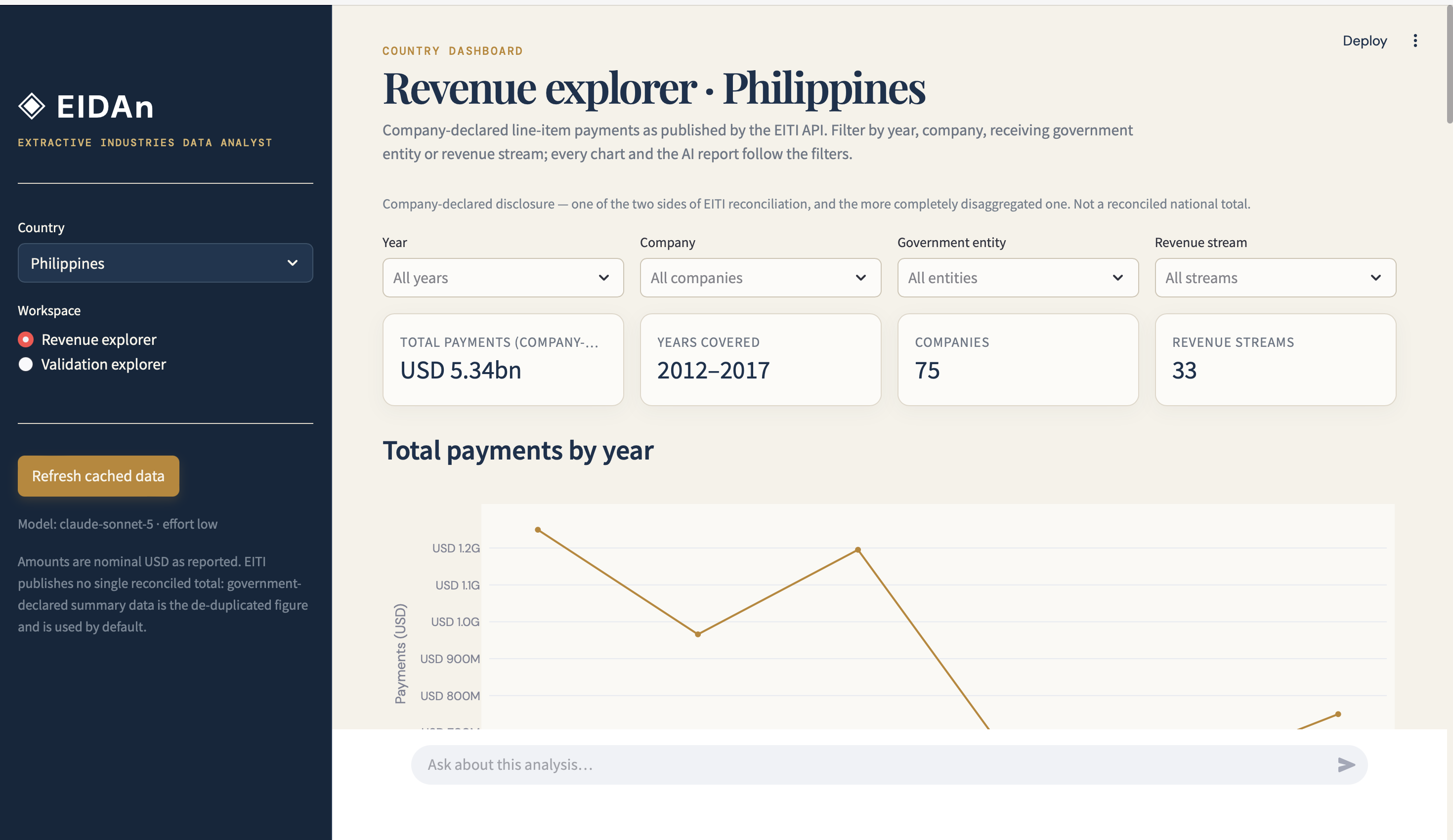
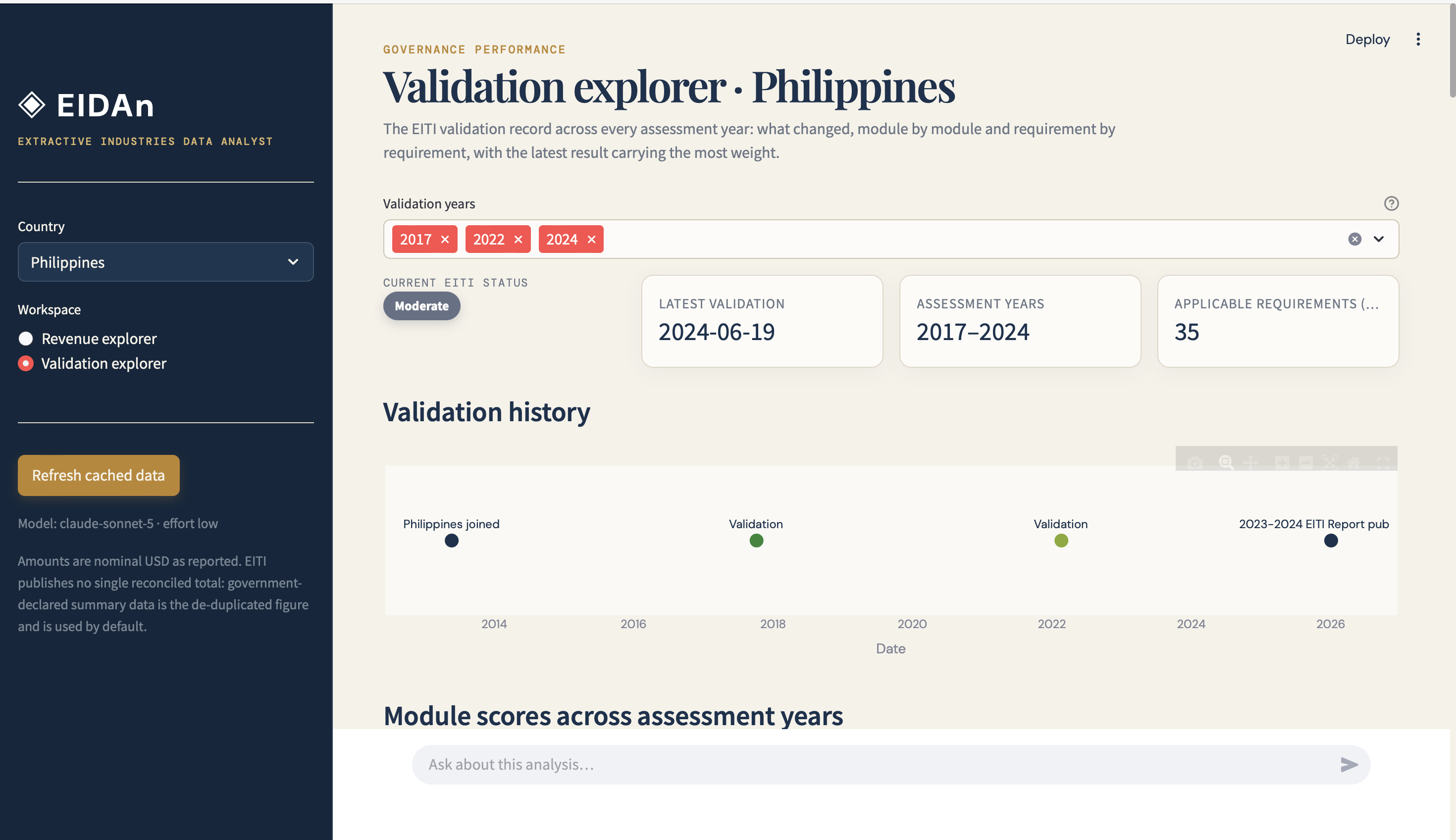
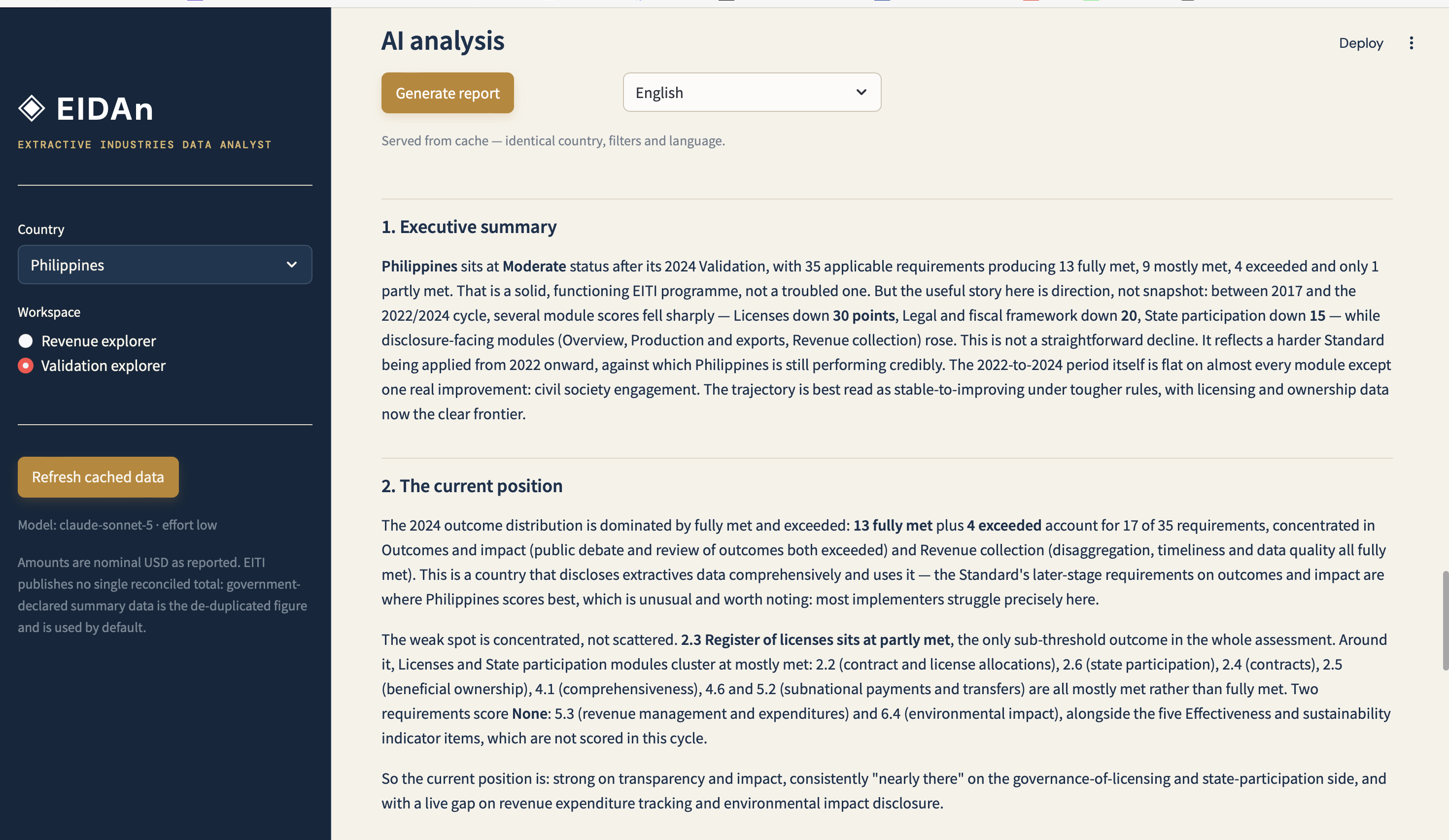
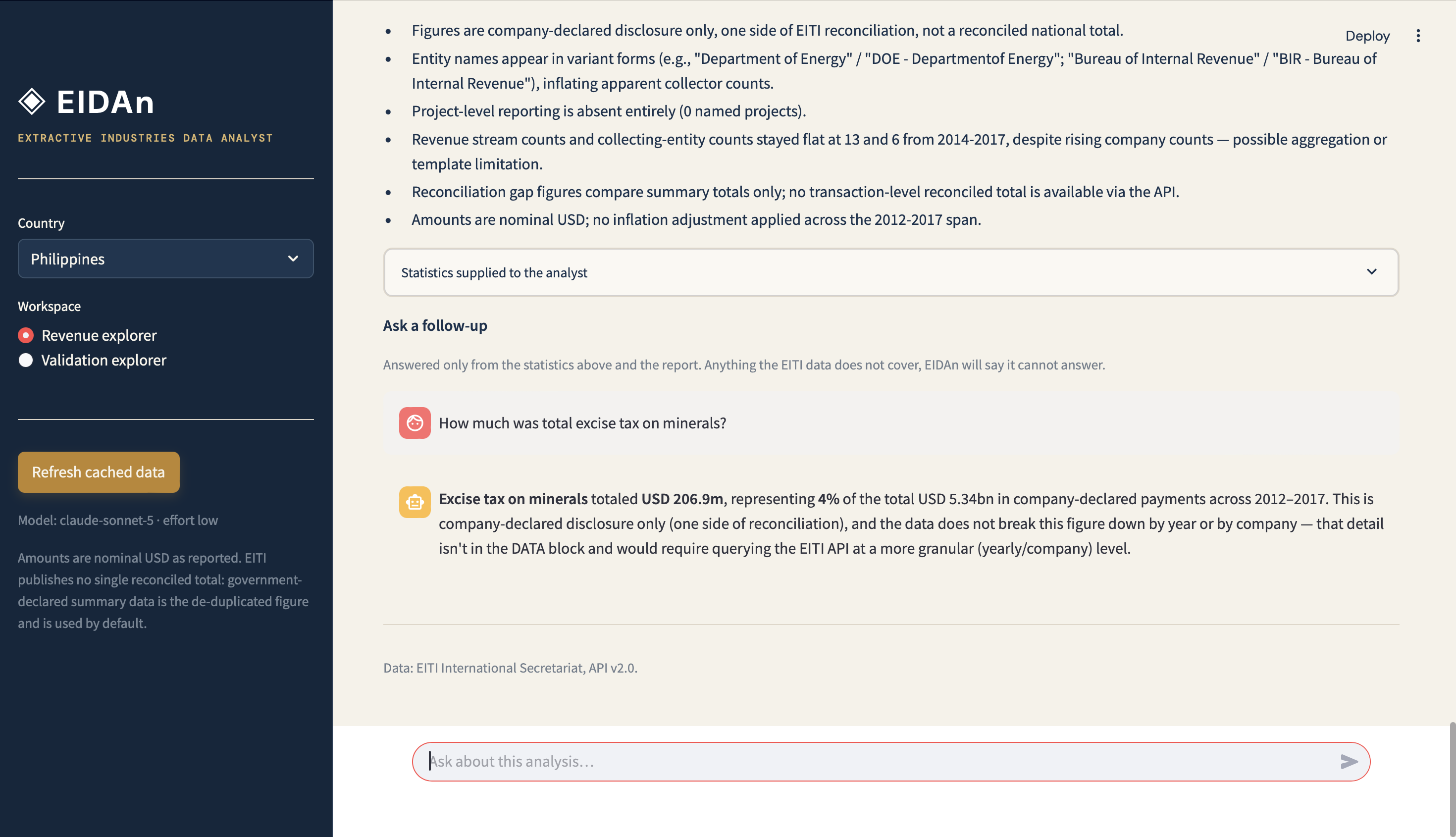
<p>So as an experiment, I developed a tool called Extractive Industries Data Analyst or EIDAn for short. It is essentially an AI-powered dashboard that allows us to generate summary reports and ask follow-up questions about our data.</p>

<div class="gallery">
  <img src="/assets/images/blog/eidan-revenue1.png" alt="EIDAn Revenue Explorer" />
  <img src="/assets/images/blog/eidan-validation1.png" alt="EIDAn Validation Explorer" />
  <img src="/assets/images/blog/eidan-aireport.png" alt="EIDAn AI summary report generator" />
  <img src="/assets/images/blog/eidan-aidata.png" alt="EIDAn statistics supplied to the model" />
  <img src="/assets/images/blog/eidan-followup.png" alt="EIDAn follow up question to the summary report" />
</div>

<p>EIDAn currently has two pages which are the Revenue Explorer and the Validation Explorer. It allows the user to filter by country, company, government agency, revenue stream, and years. It also has data visualizations of key datasets.</p>

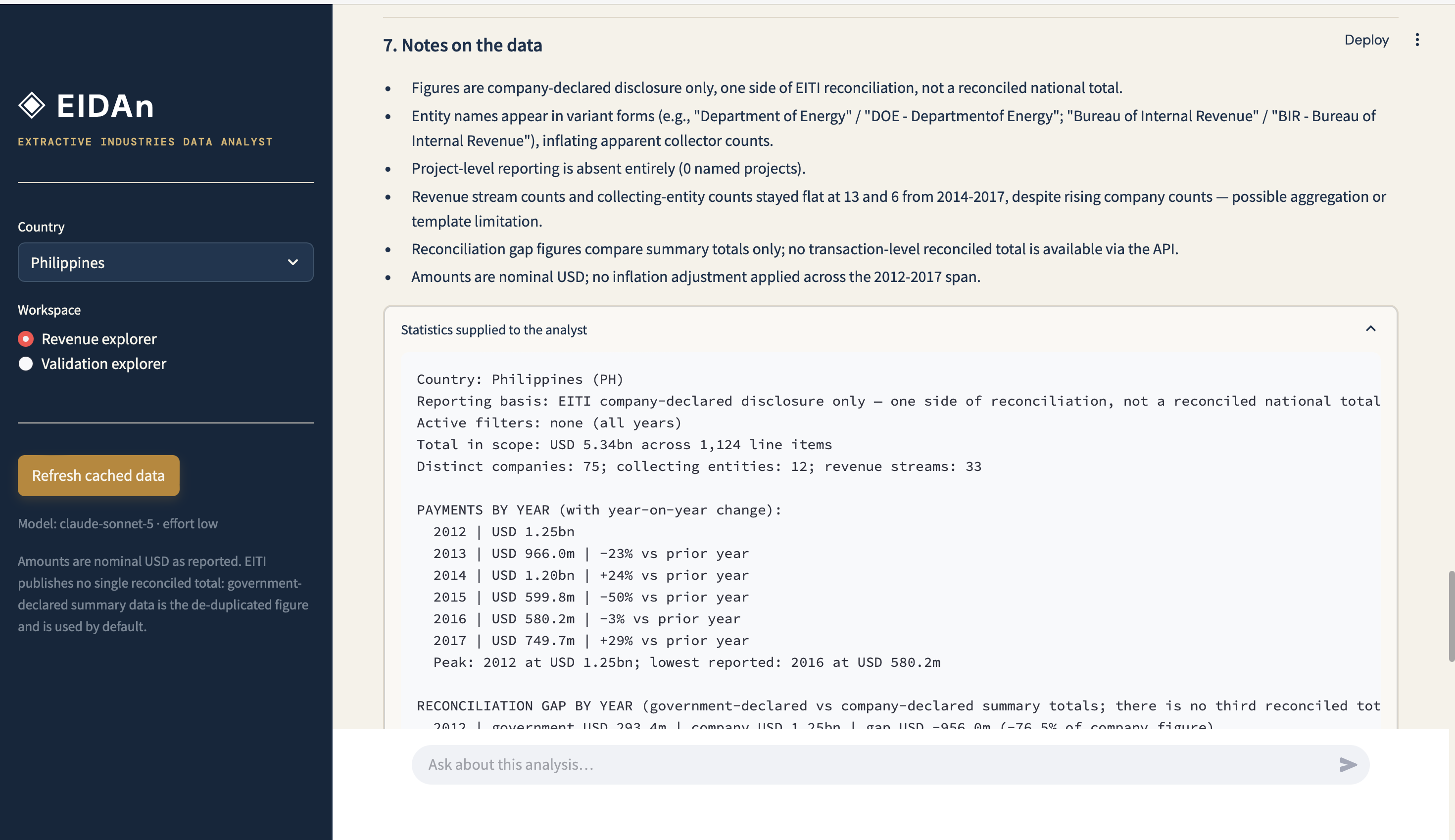
<p>Users can ask it to generate an AI summary report of the current dataset in multiple languages. It takes about 10-15 seconds to generate a single report and costs around 5 cents USD. A user can then ask a follow-up question, like which reforms should the MSG prioritize, and it gives a short response which costs about one US cent. The tool also gives a glimpse of the statistics used by the model to generate its report. This is to make sure that the answers are traceable.</p>

<p>A user could just upload their dataset to tools like ChatGPT and analyze their data from there. But the difference with using EIDAn is the source. ChatGPT and other LLM tools draws on everything it has read and on whatever it finds in the internet. With EIDAn, every number comes straight from the EITI API or data repository. EIDan also has a built-in protocol wherein it explicitly says it does not have enough data to answer a question instead of guessing or hallucinating.</p>

<p>In building AI-tools, I believe that it is important to be transparent about how the tool looks on the inside to build trust among users. Again, EIDAn is built exclusively on EITI data using EITI’s API. This helps address the concern around hallucination which AI is very prone to when it doesn’t have the data to answer the question it is asked. It uses Claude’s Sonnet model to generate the report primarily for cost and efficiency reasons.</p>

<p><strong>What about the risks in using AI and how can we do better?</strong></p>

<p>While the use of AI comes with some benefits, it also comes with risks. At the top of my list is the concern around AI replacing humans which I personally think is not the case and should not be the case. As it is, LLMs like ChatGPT are still not capable of replacing human creativity and critical thinking. I believe that AI should only be used to make parts of our work more efficient such as collecting, cleaning, summarizing, and visualizing data. From my experience at the Philippine EITI Secretariat many years ago, these tasks can take hours if not days when done manually. The time, energy, and resources we save from using AI can be reallocated for things like stakeholder outreach and policy reforms.</p>

<p>It is also worth highlighting about the risk of AI giving wrong and/or biased answers which is why in implementing AI tools like chatbots, high-quality open data is very important. Because at the heart of AI governance is actually open data governance. For EITI countries who want to use AI tools on their data, we need to:</p>

<ol>
  <li>Revisit our open data policies to first make sure that our <strong>datasets are of good quality and machine-readable</strong>. There is this saying in AI that goes like garbage in, garbage out. When data is poor, so will the responses be.</li>
  <li>Be proactive and <strong>adapt principles to govern how we use it</strong> to harness the full potential of AI and mitigate the risks. Chief among these principles is transparency. We need to be able to explain to our stakeholders what goes into our AI tools. Answers should also be traceable.</li>
  <li>Put in place <strong>accountability mechanisms</strong> meaning there should still be human ownership and oversight within the Secretariat or MSG to check AI’s outputs especially in high-stake scenarios in the future.</li>
</ol>

<p><strong>Moving forward</strong></p>

<p>As we use more and more of AI with EITI data, we need to make sure that our EITI data is of high quality and in open formats. Lastly, I hope that we proactively adapt governance principles and rules that ensure AI is used responsibly.</p>

<p>For my next blogs posts on this topic, I plan to feature other AI-powered tools used by other EITI stakeholders.</p>

<style>
.lightbox-overlay {
  display: none;
  position: fixed;
  inset: 0;
  background: rgba(0,0,0,0.92);
  z-index: 1000;
  cursor: zoom-out;
  align-items: center;
  justify-content: center;
}
.lightbox-overlay.active { display: flex; }
.lightbox-overlay img {
  max-width: 90vw;
  max-height: 90vh;
  object-fit: contain;
  box-shadow: 0 0 40px rgba(0,0,0,0.5);
}
</style>

<div class="lightbox-overlay" id="lightbox">
  <img id="lightbox-img" src="" alt="" />
</div>

<script>
const lb = document.getElementById('lightbox');
const lbImg = document.getElementById('lightbox-img');
document.querySelectorAll('.gallery img').forEach(img => {
  img.addEventListener('click', () => {
    lbImg.src = img.src;
    lbImg.alt = img.alt;
    lb.classList.add('active');
  });
});
lb.addEventListener('click', () => lb.classList.remove('active'));
document.addEventListener('keydown', e => {
  if (e.key === 'Escape') lb.classList.remove('active');
});
</script>]]></content><author><name>Marco Zaplan</name></author><category term="extractives" /><category term="open data" /><category term="AI" /><summary type="html"><![CDATA[AI use in the extractives is on the rise. How can maximize its use while mitigating the risks?]]></summary></entry><entry><title type="html">Reflections on my 5-year open extractives data journey</title><link href="https://marcozaplan.github.io/blog/2020/03/reflections-on-my-5-year-open-extractives-data/" rel="alternate" type="text/html" title="Reflections on my 5-year open extractives data journey" /><published>2020-03-07T00:00:00+00:00</published><updated>2020-03-07T00:00:00+00:00</updated><id>https://marcozaplan.github.io/blog/2020/03/reflections-on-my-5-year-open-extractives-data</id><content type="html" xml:base="https://marcozaplan.github.io/blog/2020/03/reflections-on-my-5-year-open-extractives-data/"><![CDATA[<p>On my first week at Bantay Kita - PWYP Philippines back in June 2015, I was tasked to create primers using subnational data from the Philippine EITI report. Open data was on its early days then. To be able to analyze the data, I had to… manually encode the data from the paper report. That task took so much of my time and I even got some data wrong. Fast forward to 2020 and we are now drowning in datasets with plenty of online portals publishing even more data. How far has our movement gone?</p>

<p>Open data used to be the exception but has now become the norm backed by policies and legal frameworks. We have made extractives data more accessible to the public. We have organized dozens, if not hundreds, of capacity-building activities at various levels and platforms. We have published numerous reports and pieces using open extractives data. Without a doubt, we as an international community scored big wins. Here are three of my favorites:</p>

<p>Firstly, we got more countries to commit to open extractives data. The EITI Standard 2019 now requires all of its 53 implementing countries to publish data in open format. And of course, we also have the European Union’s Mandatory Disclosures Policy and Canada’s ESTMA. We made open extractives data the talk of the town. But still, commitment is different from implementation. According to the Open Data Index 2017, there remains a wide disparity among EITI countries when it comes to disclosing broader open datasets and I think this is one area where we can do better in.</p>

<p>Secondly, we got more relevant datasets out and accessible. Many years ago, the focus has mostly been country-level payments data. Today, these datasets remain at the top but it now shares that spot with other important and relevant disclosures on beneficial ownership, state-owned enterprises, local content, project-level payments, and social and environmental impacts. As more datasets became available, so did online portals providing us easier access to these disclosures. The Natural Resource Governance Institute (NRGI) launched international and national portals and with EITI’s push for systematic disclosure, implementing countries are now opting to disclose data online rather than in paper reports.</p>

<p>Most importantly, we have built active communities of practitioners who uses extractives data. Publish What You Pay’s Data Extractors Program, which started in 2015, is one of those programs that paved the way for more uses of open extractives data alongside the many capacity-building initiatives of NRGI, EITI, and OpenOil, to name a few. I was among those fortunate data extractors to receive guidance and support from the network. For me, this is the biggest win we have had so far. Because no matter how much datasets are put out in the open, they’d be just spreadsheets if nobody uses them. In the last few years, the network pulled together time and resources and invested in a generation of advocates who not only knows the issues but are also highly capable of accessing, analyzing, applying, and advocating for open extractives data. And I think that’s very powerful.</p>

<p><strong>Closing</strong>
Four years and eight months ago, I had to manually encode data from our EITI report just to be able to analyze the data. Today, we have online portals and datasets that are published in open format by default. We are in a much better place now than we were five years ago thanks to the many years of hard work rendered by many people from the extractives transparency movement. We have definitely come a long way and this sentence won’t be complete without me saying ‘yet we still have a lot more to do’. But I’ll save that for another post.</p>

<p>To end this piece, allow me to quote an old piece I wrote four years ago:</p>

<p>“Globally making data available and open is often seen as the end in itself. Making data available, open, and relevant is different in that it makes the whole advocacy on data work for local communities as well.”</p>

<p>I look forward to that day when more and more open extractives data actually shape resource governance reforms, hold institutions to account, and benefit communities impacted by extractives - today and tomorrow.</p>

<p>To my fellow advocates from civil society, government, and industry, a ​Happy Open Data Day 2020 to us all! May we all continue the good fight.</p>]]></content><author><name>Marco Zaplan</name></author><category term="extractives" /><category term="open data" /><summary type="html"><![CDATA[On my first week at Bantay Kita - PWYP Philippines back in June 2015, I was tasked to create primers using subnational data from the Philippine EITI report.]]></summary></entry><entry><title type="html">Who wins if Zimbabwe joins the EITI?</title><link href="https://marcozaplan.github.io/blog/2020/02/who-wins-if-zimbabwe-joins-the-eiti/" rel="alternate" type="text/html" title="Who wins if Zimbabwe joins the EITI?" /><published>2020-02-20T00:00:00+00:00</published><updated>2020-02-20T00:00:00+00:00</updated><id>https://marcozaplan.github.io/blog/2020/02/who-wins-if-zimbabwe-joins-the-eiti</id><content type="html" xml:base="https://marcozaplan.github.io/blog/2020/02/who-wins-if-zimbabwe-joins-the-eiti/"><![CDATA[<p>Recent news, which the government has not refused, suggested that Zimbabwe is not keen on joining the Extractive Industry Transparency Initiative (EITI). By joining EITI, the mining sector - the main engine for economic growth, would have been opened for citizens to question government and industry on how past and current mining deals are best tailored to contribute Sustainable Development Goals (SDGs).</p>

<p>Last year in October, the government launched a blueprint to grow mining sector earnings by 344% to US$12 billion in 2023, up from just US$2.7 billion earned in 2017. Based on past records and with the plunder on Marange diamonds, however, citizens have become skeptical that the envisaged mining sector growth will revamp education and health services.</p>

<p>What the country needs is a framework like the Extractive Industries Transparency Initiative (EITI) to help surface issues, bring sectors together, and build trust amongst them so that they can come up with solutions together. ​Given lack of traction on joining EITI, it is pertinent to reflect on the potential governance gains associated with implementation of EITI – who wins if Zimbabwe joins EITI? ​</p>

<p><strong>Winner: Government</strong>
According to the Transparency International’s 2019 Corruption Perception Index (CPI), Zimbabwe continues to perform badly when it comes to fighting corruption. With a total score of 24 over 100, Zimbabwe is lowly ranked 158 out of 180 countries by the CPI. Fighting corruption is on the top of the government’s agenda; the public remains sceptical, though. Joining the EITI will not increase transparency overnight but it will help the government manage the extractives sector in a more inclusive and transparent manner. Raising transparency will also help minimize speculations and distrust towards the government.</p>

<p><strong>Winner: Host communities and civil society organizations</strong>
Zimbabwe has a lot to work on when it comes to citizen engagement. According to the World Governance Index 2017 edition, Zimbabwe scored -1.196 when it came to the “Voice and Accountability” indicator which indicates weak performance. By joining the EITI, mining communities and CSOs earn a platform to access information and constructively engage with companies and the government. For a government that seeks to rebrand as a “New Dispensation” and breaking away from old habits of keeping citizens in the dark on mining deals, joining EITI is critical to winning doubters.</p>

<p><strong>Winner: Mining investors and companies</strong>
While Zimbabwe was not ranked lowest when it comes to the Mining Investment Attractiveness Index 2018 of the Fraser Institute, it also fares badly on Policy Perception Index compiled by the same institute. The Investment Attractiveness Index blends mineral wealth potential and policy attractiveness.  Joining the EITI can become a game changer for the country as it aims to open the country for a business to attract more investments into the mining sector. Transparency helps level the playing field and ensure that no affiliate of those in power gets more favourable mining contracts. By supporting transparency initiatives, investors can freely compete with one another regardless of affiliation. It also makes doing business in Zimbabwe less riskier for international investors who are bound by laws on foreign corrupt practices like those in the US and Australia.</p>

<p><strong>Should Zimbabwe join the EITI?</strong>
A country like Zimbabwe, whose economy is dependent on its vast mineral wealth, embracing EITI is a critical building block to curb corruption, prove the seriousness of the agenda to open Zimbabwe for business, and to regain public confidence and trust. Regressive elements in government will always find excuses not to open up the mining sector for public scrutiny. To prove that this is a new dispensation, actions should speak louder than words.Joining EITI can show that the government is walking the talk.</p>]]></content><author><name>Marco Zaplan</name></author><category term="extractives" /><category term="open data" /><summary type="html"><![CDATA[Recent news, which the government has not refused, suggested that Zimbabwe is not keen on joining the Extractive Industry Transparency Initiative (EITI).]]></summary></entry><entry><title type="html">Five concrete ways communities can maximize the new EITI Standard</title><link href="https://marcozaplan.github.io/blog/2020/01/five-concrete-ways-communities-can-maximize/" rel="alternate" type="text/html" title="Five concrete ways communities can maximize the new EITI Standard" /><published>2020-01-30T00:00:00+00:00</published><updated>2020-01-30T00:00:00+00:00</updated><id>https://marcozaplan.github.io/blog/2020/01/five-concrete-ways-communities-can-maximize</id><content type="html" xml:base="https://marcozaplan.github.io/blog/2020/01/five-concrete-ways-communities-can-maximize/"><![CDATA[<p>The new Extractive Industries Transparency Initiative (EITI) Standard is like the latest smartphone in the market - it is fancy on the outside but packed with useful features on the inside. Implementing it comes with a real cost to its 52 implementing countries but by unlocking the potential of these new features can we say that it is actually worth it. </p>

<p>Payments data from two years ago is so 2003. The EITI Standard is so much more than that now. Communities have a lot to potentially gain from the new and improved requirements - if and only if that potential is harnessed. Here are just some of the ways communities can use the EITI Standard to ensure that their natural resources are governed in a sound manner.</p>

<p><strong>1. How much money will go to communities until the resource run out? Use the contracts transparency requirement.</strong>
The improved contracts transparency requirement now asks countries to disclose licenses granted by government. It is cool to know to whom it was granted and when it was signed and will expire. But communities should also demand for attachments to these contracts.</p>

<p>One document they should specifically look into is the feasibility study. In it is a section on economic feasibility which tells how much money will be generated and how much taxes will be paid among many others.</p>

<p>CTP Construction and Mining Corporation in the Municipality of Carrascal in the Philippines will directly pay Php 93.3 million in local taxes and fees throughout the life of its mine. This is according to its approved mining project feasibility (MPF) document as disclosed through the Philippine EITI Contracts Portal.</p>

<p>This is a helpful insight in:</p>
<ul>
  <li>managing expectations;</li>
  <li>long-term development planning; and</li>
  <li>revenue monitoring.</li>
</ul>

<p><strong>2. Does the mining operation put the host community at risk of landslide? Again, use the contracts transparency requirement.</strong>
Another attachment in the contract is the site map which contains the coordinates of the license. Communities can use the map to see where the operation will accurately take place.</p>

<p>They can ask a GIS expert to map the coordinates and check whether the operation overlaps with government-declared biodiversity areas, indigenous peoples’ lands, and landslide prone areas among many others.</p>

<p>This information will be helpful in:</p>
<ul>
  <li>ensuring the company honors other land claims;</li>
  <li>monitoring whether the operation is sticking to its allowed area; and</li>
  <li>making sure environmental risks are accounted for.</li>
</ul>

<p><strong>3. How are environmental impacts and risks mitigated? Use the environmental reporting requirement.</strong>
With the new Standard comes environmental reporting. Communities must demand information on not just how much was spent on environmental protection but also the very basis of these expenditures which is the environmental impact assessment (EIA) reports.</p>

<p>Communities can use this document to look into what the impacts are, how it will affect them, and how the company and government plans to mitigate them.</p>

<p>The environmental impact statement (EIS) of Greenstone Resources Corporation in the province of Surigao del Norte in the Philippines clearly stated the impacts of the operation on the land and how it plans to mitigate them.</p>

<p>Information such as this will support communities in:</p>
<ul>
  <li>monitoring company obligations;</li>
  <li>holding relevant government agencies accountable; and</li>
  <li>incorporating the mitigation measures into other local plans such as disaster-risk reduction (DRR) plans.</li>
</ul>

<p><strong>4. Do government officials have a stake in mining companies? Use the beneficial ownership requirement</strong>
The new Standard now requires countries and companies to disclose who their real owners are. This is easier said than done, of course. Information which will come out from the EITI will definitely not be perfect but it can be a good step towards further research.</p>

<p>Communities may engage organizations specializing on beneficial ownership like Open Ownership to cross-reference the information against other filings and generate a more accurate picture of an extractive company’s ownership structure.</p>

<p>A study conducted by Madeiline Aloria and commissioned by Bantay Kita shows government officials and their relatives holding interest in mining companies in the Philippines. Link to the study here: https://www.bantaykita.ph/for-publications/unmasking-the-helmsmen</p>

<p>This information would be helpful in:</p>
<ul>
  <li>making sure operations are ran by companies with good track record;</li>
  <li>companies are are not avoiding domestic taxes;</li>
  <li>ensuring government officials and their affiliates have no stake in the industry to avoid conflicts of interest; and
-local ownership rules are followed by foreign companies.</li>
</ul>

<p><strong>5. Where to even begin? Maximize the multi-stakeholder group (MSG) requirement.</strong>
Gathering all the information above for communities is not an easy task which is why there is the multi-stakeholder group (MSG) to do that for them. Remember that the MSG governs the national EITI implementation and consists of representatives from government, industry, and civil society organizations (CSOs).</p>

<p>CSO representatives must be able to effectively demand for the information above by (1) leveraging the requirements under the Standard and by (2) justifying the real value and applications of such disclosures to communities.</p>

<p>If not all of them can be disclosed at once, disclosure-by-installments may be negotiated with government and companies. Because having some is better than none at all. Lastly, CSOs should argue for timely data especially if the information is being collected already. #mainstreaming</p>

<p><strong>Can EITI change the world?</strong>
We have probably heard the old saying EITI is not a silver bullet a few billion times already. True enough, it isn’t the solution to all our resource governance problems. Because data and reports alone will not turn countries to economic powerhouses or degraded lands into the next Amazon forest. EITI is simply… a means to an end. Mere implementation for the sake of compliance will not produce long-term, tangible results. But by utilizing EITI to push for informed and inclusive reforms for those most impacted by extractives can the full potential of the initiative be maximized.</p>]]></content><author><name>Marco Zaplan</name></author><category term="extractives" /><category term="open data" /><summary type="html"><![CDATA[The new Extractive Industries Transparency Initiative (EITI) Standard is like the latest smartphone in the market - it is fancy on the outside but packed with useful features on the inside.]]></summary></entry><entry><title type="html">Have Westerosis benefited from their natural resources?</title><link href="https://marcozaplan.github.io/blog/2017/08/have-westerosis-benefited-from-their-natural-r/" rel="alternate" type="text/html" title="Have Westerosis benefited from their natural resources?" /><published>2017-08-17T00:00:00+00:00</published><updated>2017-08-17T00:00:00+00:00</updated><id>https://marcozaplan.github.io/blog/2017/08/have-westerosis-benefited-from-their-natural-r</id><content type="html" xml:base="https://marcozaplan.github.io/blog/2017/08/have-westerosis-benefited-from-their-natural-r/"><![CDATA[<p>Gold, silver, iron, and copper in Westeros has been exploited for centuries yet extraction only benefited a few great houses and their lords and ladies. Inequality and poverty remains a constant development issue in the realm. Here comes Daenerys <insert ALL="" titles="" here=""> with her three dragons aiming to conquer all Seven Kingdoms. If she wins the Game of Thrones, how can she turn Westeros’ resource wealth to sustainable development?</insert></p>

<p>[Spoilers ahead]</p>

<p><strong>Learn from the Lannister-induced resource curse in Westerlands</strong>
Gold mining in Casterly Rock minted (pun intended) the richest family in Westeros - the Lannisters. For generations, the Lannisters exploited gold in Casterly Rock. Some estimates put their gold at 18 billion dragon gold.</p>

<p>By Season 7, the Lannisters had to rob the Tyrells <sobs very="" heavily=""> of their harvests and gold to pay the Crown's debts owed to the Iron Bank because their own reserves ran dry. What happened with all that gold?</sobs></p>

<p>Lannisters put their money where their mouth is and sadly that is not human capital, infrastructure, and economic diversification. Instead, they used their gold to fight wars and build their military strength (also throw lavish parties and buy Dornish wine). Gold has ran dry and yet other industries have not spawned. This is important as their lands are not the most fertile in the realm making agriculture difficult. They did not bother diversifying westerlands’ local economy. Why would they when their source of income seemed endless and quick?</p>

<p>There is no such thing as forever in mining and Cersei learned this the hard way. Daenerys needs to be well aware of this if she is to rule the Seven Kingdoms. Every mining project has a start and end a.k.a. life-of-mine. Lannisters should have prepared for the day when their mines would run dry. They did not. </p>

<p><strong>Be transparent, consultative, and strategic in governing natural resources</strong>
If you need to send your best friend to the Citadel and try to be a maester just to find out where dragonglass can be mined, it only shows the grave information asymmetry in the Seven Kingdoms. Had that information been available to the public, the show would have ended three seasons ago. Making this information public allows for efficient exploitation since exploration activities would be limited to areas with most potential. This information would give Daenerys or her negotiators (possibly Tyrion) bargaining power during contracts negotiations without using Drogon.</p>

<p>When Jon Snow asked to mine dragonglass underneath Dragonstone, Daenerys consented to the extraction. There was little negotiation except that she asked him to bend the knee (pride &gt; sustainable development). Will the mineral extracted be paid for? Certainly not. There was no mention of royalties or payment for the dragonglass. The terms were entirely verbal and nothing in written form i.e., contract. No public consultation or environmental impact assessment was conducted (possibly because whites are marching quick!). Holding Dany or Jon accountable in the event of social conflicts or environmental degradation in the future will be difficult. ​​​​​</p>

<p>If Daenerys is to rule the Seven Kingdoms, the Crown needs to be transparent, consultative, and strategic in negotiating terms for the extraction of its finite resources or she will be no different to the Lannisters. Extraction has to be done by the most technically and financially capable contractors and not by your incapable relatives/love interests who knows nothing.</p>

<p><strong>Develop downstream industries and sound management of mining revenue</strong>
Westerosi economy is primarily agricultural. Revenues from mining, however, can be a source of capital to develop other sectors of the local economy. But not too quick because this will cause the economy to overheat and send prices off the chart! Investing in Essos can be an option. </p>

<p>Westeros have skilled smithies and forgers. Daenerys and the Small Council only need to create linkages between miners and processing sectors of the economy. This is to maximize value from Westeros’ minerals and create more jobs. The Crown can trade these goods and continuously develop other sectors such as the service economy (not necessarily Baelish’ brothels though).</p>

<p>Once mining revenues start to come in, Daenerys needs to invest part of it in building infrastructure to facilitate trade. She needs enormous spending on human capital - education and health, if her welfare-for-the-people rhetoric is to be genuinely realized. She might want to establish a Stabilization Fund or Future Fund (similar to Ghana’s!). These funds would help the Crown’s finances stabilize during the rainy days (or long winters in the case of Westeros) and in the event when the minerals run out.</p>

<p>Daenerys needs to be wise in managing revenues from mining. This means being prudent and not as lavish as the Lannisters.</p>

<p><strong>Conclusion</strong>
Just when you thought Game of Thrones is all about mythical creatures and blood, you are wrong. It also sheds important lessons for many resource-rich countries today.</p>

<p>Dear Khaleesi,</p>

<p>Mineral resources are nonrenewable. Extracting them offers a one-time opportunity to contribute to the sustainable development of its owners - Westerosis. Social and environmental costs need to be accounted for. Benefits need to be maximized or they will just go to waste (or to Dornish wine).</p>

<p>Sincerely,</p>

<p>Marco
Your subject/resource governance consultant</p>]]></content><author><name>Marco Zaplan</name></author><category term="extractives" /><category term="open data" /><summary type="html"><![CDATA[Gold, silver, iron, and copper in Westeros has been exploited for centuries yet extraction only benefited a few great houses and their lords and ladies.]]></summary></entry><entry><title type="html">Why we need financial modeling</title><link href="https://marcozaplan.github.io/blog/2016/11/why-we-need-financial-modeling/" rel="alternate" type="text/html" title="Why we need financial modeling" /><published>2016-11-05T00:00:00+00:00</published><updated>2016-11-05T00:00:00+00:00</updated><id>https://marcozaplan.github.io/blog/2016/11/why-we-need-financial-modeling</id><content type="html" xml:base="https://marcozaplan.github.io/blog/2016/11/why-we-need-financial-modeling/"><![CDATA[<p>Prices of oil and minerals can go really high. A country may benefit given the right fiscal regime. During the boom cycle in the latter half of the previous decade, many resource-rich countries saw their budgets swelling (and their dictators happy). Along with it came their spending as well.</p>

<p>Then the unexpected happened. Prices reached all-time lows since 2011. Resource-dependent countries are now struggling with a fiscal crisis caused by their lack of diversification and prudence in spending in the past.</p>

<p>What can governments do about this? Plan for the long-term.</p>

<p>There are lots uncertainties and risks that could happen in the life of a resource project. Expectations can be set too high, in some cases. Financial models are simplified projections of these possible scenarios.</p>

<p>Why should governments and civil society organizations do financial modeling? Here are three of the many reasons why.</p>

<p><strong>1. Prices are volatile and outcomes vary per scenario</strong>
Just when you thought you were the moodiest person in the room, then you haven’t met oil and mineral prices. They change. A lot. When governments are not prepared for the worst case scenarios, their budgets suffer. Their expenditures including social services, debt servicing, and infrastructure spending are put at risk. This is true not just at the national level but more so for local governments who are dependent on extraction of natural resources.</p>

<p><strong>2. Natural resource extraction rakes in tons of money and timing is key</strong>
Governments can only spend so much but when big money starts to kick in, they end up spending on the closest thing they can put their hands on when unprepared. It’s like you binge online shopping when you get (or are expecting) a raise. This is where long-term planning is important. If governments can’t tell (roughly) how much money is coming at which year, they fail to plan for where the money should go.</p>

<p>Civil society organizations (CSOs) and communities should also be able to compare the projected and actual amounts of extraction and payments. Did the government receive what companies claim to pay at year x? If not, what could explain the deviation? Was it because of lower prices or something else? This holds governments and companies accountable to the citizens.</p>

<p><strong>3. Tons of money invites bad temptations</strong>
Kleptocrats lurk around where it is darkest. If watchdogs including CSOs and communities do not know how much money a resource project would generate at given year x, corrupt government officials can easily operate in a veil of secrecy.</p>

<p><strong>Should we do financial modeling?</strong>
An important caveat, however, is this: financial models operate under many assumptions. Hence, should be used with caution. A financial model can aid in projecting government revenue from a resource project at a given period. It can also provide affected communities and CSOs an opportunity to better monitor resource projects operating near their community. They are not the sole solution to the resource curse but they make a whole lot of difference. </p>

<p>Government has a lot to lose when benefits from resource projects are not maximized. Communities lose a one-time opportunity to improve their living conditions when benefits are enjoyed by the very few. Hence, governments and communities have the most to gain when projects are better planned for and monitored.</p>]]></content><author><name>Marco Zaplan</name></author><category term="extractives" /><category term="open data" /><category term="financial modeling" /><summary type="html"><![CDATA[Prices of oil and minerals can go really high. A country may benefit given the right fiscal regime.]]></summary></entry><entry><title type="html">5+ tools every data extractor needs to know</title><link href="https://marcozaplan.github.io/blog/2016/10/5-tools-every-data-extractor-needs-to-know/" rel="alternate" type="text/html" title="5+ tools every data extractor needs to know" /><published>2016-10-28T00:00:00+00:00</published><updated>2016-10-28T00:00:00+00:00</updated><id>https://marcozaplan.github.io/blog/2016/10/5-tools-every-data-extractor-needs-to-know</id><content type="html" xml:base="https://marcozaplan.github.io/blog/2016/10/5-tools-every-data-extractor-needs-to-know/"><![CDATA[<p>This post was first published in the Publish What You Pay Website on October 28, 2016</p>

<p>Asking why we need to use data is like asking why we fall in love or breathe. We need to use data for the simple reason that it’s available left, right and centre. As advocates, data scientists, government officials, campaigners, and ordinary citizens, we have the key to making meaningful change happen in our own communities.</p>

<p>However, with tons of extractive industries’ data recently made available, we sometimes find ourselves trapped and lost, not knowing what to do next. We ask ourselves (in front of the mirror, in some cases) questions like: will this data be relevant to the affected communities? What is this data trying to tell me? Where do I find this kind of extractives data? How do I organise my data project ideas?</p>

<p>How do I turn data into impact?</p>

<p>Don’t stress out. We’ve got you covered. So make some tea or coffee, sit down, forget that heartbreak and move forward.</p>

<ol>
  <li>Data needs to be relevant to your audience</li>
</ol>

<p>Otherwise, your audience will take the data for granted or ignore it. When you don’t know what data your communities or audience need, you can use a data user template. It’s a simple and handy tool for your communities to fill out. It asks them what issues matter to them and helps them identify the decision-maker or key stakeholder, and the data they need the most. This makes data you want to work on relevant to your audience and their advocacy. You can download the guide, template, and case study here.</p>

<ol>
  <li>Data should be available and open.
When you don’t know where to find data, especially extractives data, use one of the many existing open data portals out there. Trust me, there are many fish in the sea.</li>
</ol>

<p>Here’s a short list:
– EITI.org – for data disclosed in EITI reports from 49 countries as of 2015.
– World Bank and IMF – where you will find macro-indicators and some extractives data such as trade data, resource rent as a percentage of GDP, etc.
– For country-specific extractives data, you can check open data portals for USA, Lebanon, and Philippines.</p>

<ol>
  <li>
    <p>Data needs to be understood and analyzed. 
When you have loads of data to analyse, you can use Tableau Public. It’s a powerful tool but requires some time to learn. It lets you visually analyse data by dragging and dropping variables such as extractives tax payments, production and so on into a dashboard. This tool allows you to manipulate and play with data but not feelings. Those two are different.</p>
  </li>
  <li>
    <p>Data should leave a lasting impression.
When you have data but don’t know how to visualise or present it to your community, use Piktochart. It’s free to use and easy to learn. For tips on how to present data, here’s a blog they wrote. You can find a list of color combinations and a tool for fonts to combine with Canva to make designing hassle-free. Find some inspiration when you feel like making a data visualization here.</p>
  </li>
  <li>
    <p>Data should not just be numbers
Data should never be taken for granted because it’s there for you, no matter what! When you want to turn your extractives data into impact, use the “Innovation Tool (Modified for Data Projects)”. This tool comes with seven stages and systematises the use of data for projects. The tool first asks you to identify “Opportunities and Challenges” (i.e., release of EITI reports, EU mandatory disclosures) which then sets the direction of your entire data project. In filling out the tool, remember to focus on one stage at a time – I don’t advise working on two or three stages at a time. You can download the guide and template from page 128-129 here and a case study here.</p>
  </li>
</ol>

<p>A tool which complements the innovation tool is the “Scaling up Plan (for Data Projects) Tool” in case you want to scale up your project in the future. You can find the guide and template in the same file as the Innovation Tool from page 122-123.</p>

<p>So what?</p>

<p>Data shouldn’t be overwhelming. With the right tools, data can work for different needs. I urge you to appreciate your data as if it was the last data left in the world!</p>

<p>Happy data use!</p>]]></content><author><name>Marco Zaplan</name></author><category term="extractives" /><category term="open data" /><summary type="html"><![CDATA[Asking why we need to use data is like asking why we fall in love or breathe.]]></summary></entry><entry><title type="html">Making open data work for communities in the Philippines</title><link href="https://marcozaplan.github.io/blog/2016/10/making-open-data-work-for-communities/" rel="alternate" type="text/html" title="Making open data work for communities in the Philippines" /><published>2016-10-13T00:00:00+00:00</published><updated>2016-10-13T00:00:00+00:00</updated><id>https://marcozaplan.github.io/blog/2016/10/making-open-data-work-for-communities</id><content type="html" xml:base="https://marcozaplan.github.io/blog/2016/10/making-open-data-work-for-communities/"><![CDATA[<p>There are two types of disclosures. One is disclosure for the sake of transparency, while the other is disclosure that actually works for the people it is intended to help. Ensuring the latter is the philosophy Bantay Kita has applied to its engagement with natural resources data.</p>

<p><strong>Where are we now?</strong></p>

<p>When the Philippine’s Extractive Industries Transparency Initiative (PHEITI) Country Report was first published in 2014, an incredible amount of data was made available to the public. As a civil society representative to the PHEITI Multi Stakeholder Group, Bantay Kita was tasked with making sure that the data was used to facilitate greater accountability.</p>

<p>On July 2016, Bantay Kita soft launched its DATA Portal - short for Demanding Action, Transparency, and Accountability Portal. The portal was conceptualized in Jakarta, Indonesia during the first Publish What You Pay Data Extractors Program workshop, and later brought to life in the second Data Extractors workshop in Harare, Zimbabwe. </p>

<p>How much did it cost? $0</p>

<p>What programming language was used? I’m not even sure - I don’t know a single one.</p>

<p>How long did it take to make the prototype? Minus the snack breaks and random Facebook checking, about four hours.</p>

<p>All it really took was some creativity and a handful of free web tools, which can be learned by users in 1 to 6 hours, depending on the person’s willingness to learn.</p>

<p>There are digital metric tons of data available on extractives, but not all are relevant to specific communities. Since our soft launching in July, we have been traveling the Philippines to conduct open data workshops and collect locally translated versions of “data user templates.” We ask local CSOs to fill them out, with a specific advocacy goal they are working on in mind, and ask what kind of data would best help them to influence decision makers and other stakeholders to support their advocacy goal. This makes the data we produce not only specific to a certain community, but also relevant to them.</p>

<p>What’s quite unique about the DATA Portal is that it’s not simply a box full of big datasets and tables of data, but rather data visualizations and infographics to make the information easier to understand. This makes the the numbers less intimidating (especially for those traumatized by college algebra).</p>

<p>The portal includes data for all 18 administrative regions in the Philippines. Each “Regional Page” has subpages for its Extractive Projects Database, News about Extractives, and Extractives Statistics. On top of this, there are “Company Pages” where data for individual projects can be found, such as production numbers, government payments, employee demographics, social and environmental spending, community demographics, poverty incidence, transparency measure, and so on.</p>

<p><strong>What’s next?</strong>
The next step for the DATA Portal is to make Action and Accountability happen. To that end, we hope to begin to provide communities with quarterly data - production and sales - disclosed by extractive companies through SMS. Since most taxes and royalties are based on sales, this information will enable local communities to estimate what subnational transfers from mining activities their communities should receive, and thus enable them to plan for the following year. This information can also be used by indigenous peoples’ organizations that receive royalties. Though schedule of payments can vary, at a minimum these disclosures will allow communities to validate the accuracy of the received funds.</p>

<p>Making a difference takes more than making data open. Stakeholders need to make these disclosures relevant to communities to actually make an impact. Through our DATA Portal, Bantay Kita hopes to do just that.</p>]]></content><author><name>Marco Zaplan</name></author><category term="extractives" /><category term="open data" /><summary type="html"><![CDATA[There are two types of disclosures.]]></summary></entry><entry><title type="html">Why we need relevant data</title><link href="https://marcozaplan.github.io/blog/2016/07/why-we-need-relevant-data/" rel="alternate" type="text/html" title="Why we need relevant data" /><published>2016-07-12T00:00:00+00:00</published><updated>2016-07-12T00:00:00+00:00</updated><id>https://marcozaplan.github.io/blog/2016/07/why-we-need-relevant-data</id><content type="html" xml:base="https://marcozaplan.github.io/blog/2016/07/why-we-need-relevant-data/"><![CDATA[<p>Data can be simply numbers for some while for others it can mean either having livelihood projects or none at all. Asserting one’s right does not come from thin air. It starts with knowing what is due to you. This may sound simple if not trivial to the privileged but not for the marginalized. Transparency changes.</p>

<p>Today, we are soft launching Bantay Kita’s data portal called DATA Portal which stands for Demanding Action, Transparency, and Accountability alongside an open data workshop for CSOs and extractives affected community members. The idea of a data portal started in Jakarta, Indonesia last November 2015. I thought: when we talk about mining affected communities, do we really know who the communities are? This sparked the idea of having a portal solely for communities and by communities.</p>

<p>What does a portal for communities mean? It means that the target users are ultimately the communities and infomediaries that engage with them. Infomediaries may include grassroots NGOs, local academic institutions, and other advocacy organizations. There is a conscious effort to centralize extractives data and information that are specific to certain affected communities hence the extractives project-level, provincial, and regional data.</p>

<p>What about a data portal by communities? The DATA Portal is intended to make sure that extractives data disclosed and made available in the portal is not only specific to certain communities but also relevant. There are data that speaks to communities but if you ask them if these data are relevant them, they would probably say no to some. This is where our data user template comes in. We ask our workshop participants five simple yet important information:</p>

<ol>
  <li>Advocacy</li>
  <li>Target Audience or Decision-maker</li>
  <li>Information that decision maker needs to know</li>
  <li>Intended outcome from decision-maker</li>
  <li>Data needed</li>
</ol>

<p>These inputs will then create our inventory of extractives data needs for specific communities. Data made available to the public can be overwhelming but given the right targeting and presentation, data can be meaningful as well. They only need to be relevant (and less intimidating!). </p>

<p>We have a very long way to go to reach our objective of having a data portal for and by communities given the enormous challenges. But I’m sure we will get there. Today marks my DATA Portal Journey. I’m so excited. ​</p>]]></content><author><name>Marco Zaplan</name></author><category term="extractives" /><category term="open data" /><summary type="html"><![CDATA[Data can be simply numbers for some while for others it can mean either having livelihood projects or none at all.]]></summary></entry></feed>